AI-Generated UGC in Korea: The 2026 Disclosure Rule and When to Use a Real Creator
A founder asked me this in August. They had priced out a Korean campaign, seen the creator fees, and wanted to know why they could not just generate the videos instead. Same faces, same format, a fraction of the cost, no scheduling.
It is a fair question, and the honest answer is that AI generated content does have a place in a Korea launch. It is just not the place most people assume. And since June it also carries a rule that foreign advertisers keep missing.
What changed on June 1, 2026
Korea's Fair Trade Commission revised its guidelines on endorsement and recommendation advertising. The revision took effect on June 1, 2026.
Until then the guidelines recognized four kinds of endorser: consumers, celebrities, experts, and organizations. The revision adds a fifth, a virtual person generated with AI. If a virtual person recommends or endorses your product, you now have to disclose that they are virtual.
The disclosure rules are specific about placement.
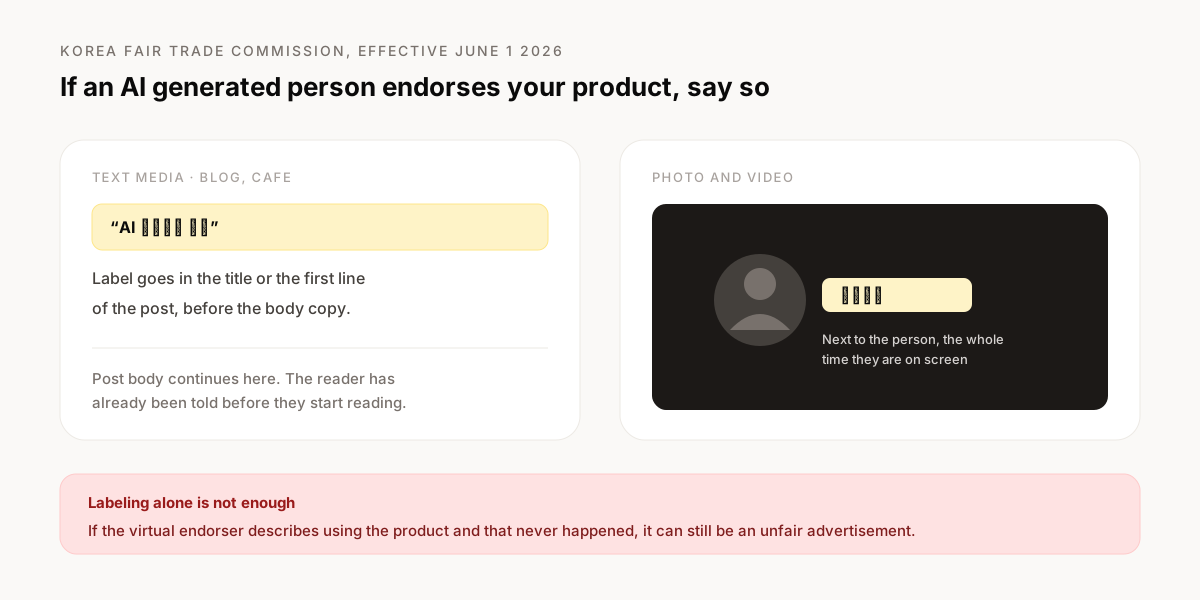
For text based media such as blogs and online cafes, the label goes in the title or at the very start of the post. The KFTC's own examples are phrases like "AI를 기반으로 생성된 가상인물이 포함된 게시물입니다" or simply "가상인물 포함".
For photo and video, the label has to sit next to the virtual person, visible the entire time they appear, and it has to be distinguishable from the background.
The part that catches people
Labeling alone does not make the ad safe.
The revision adds that even when you have disclosed the endorser is virtual, if the endorsement describes experience or use of the product, and that description does not match something that actually happened, it can still be treated as an unfair advertisement.
This is the sentence that matters for app marketing, because it removes the most common AI UGC script. A generated person saying "I have been using this for three months and it changed how I study" is exactly the case the rule describes. Nobody used it for three months. There is no person.
The KFTC said it would monitor for ads using AI generated personas without proper labeling and push for corrections.
Two practical notes. This is a review guideline under Korea's labeling and advertising law rather than a separate statute, so it tells you how the regulator reads the existing law. And it applies to advertising aimed at Korean consumers, which means a US company running Korean language ads is inside its scope. Worth a look from your own counsel before you rely on any of this.
The wider labeling law behind it
The endorsement guideline is one piece of a bigger regime that landed this year, and most foreign advertisers only find out about it after the fact.
Korea's AI Basic Act, the Framework Act on the Development of Artificial Intelligence and Establishment of Trust, took effect on January 22, 2026. Article 31 covers transparency. Operators have to give advance notice when a service runs on generative or high impact AI, label outputs produced by generative AI, and give notice plus labeling for deepfake outputs. The act applies extraterritorially, so a foreign company serving Korean users is inside its scope.
A follow up amendment took effect on July 21, 2026, spelling out the generative AI labeling obligation in more detail. The government has said it will run a grace period of at least a year while it refines the guidelines, so the practical posture right now is guidance and consulting rather than penalties.
Separately, in December 2025 the government announced an advertising specific package: anyone who creates, edits or posts AI generated images or video must label them as AI made, platform users must not remove or tamper with those labels, and platform operators carry responsibility for advertiser compliance. It also floated punitive damages of up to five times the losses caused by knowingly distributing false or fabricated content, reviews within 24 hours, and an emergency process to block harmful ads before deliberation finishes.
That last package is not all in force. It requires amendments to the Network Act, which the government said it would pursue through 2026. Treat it as direction of travel rather than current law, and check the status with counsel before you build a plan around it.
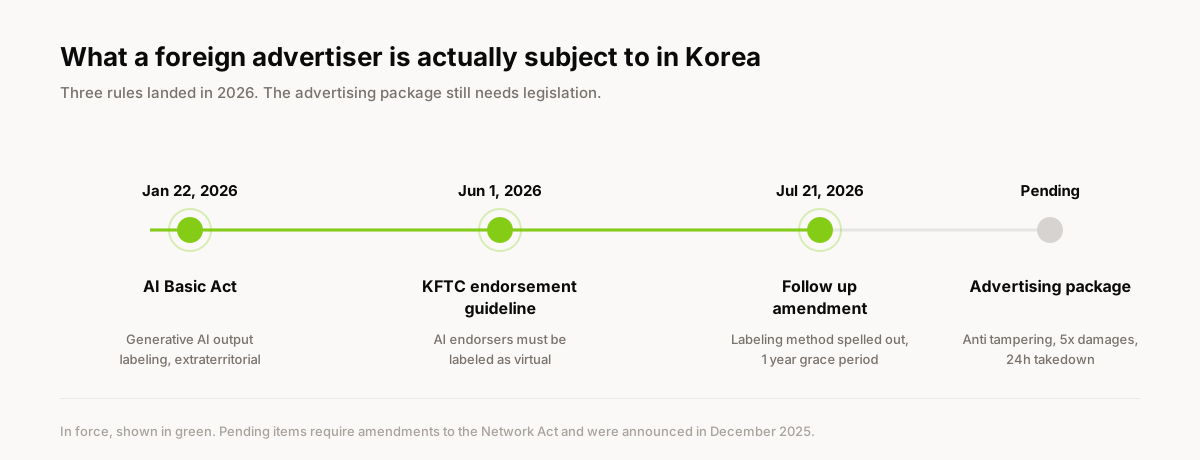
The reason all of this matters for a launch is narrower than it sounds. If you are running real Korean creators, almost none of it touches you beyond the sponsorship disclosure you were already doing. If you are generating the presenter, you are now inside three overlapping regimes at once, in a market that is actively looking for exactly that pattern.
What Korean audiences already thought
The rule did not arrive in a vacuum.
In an April 2026 consumer survey by Gong&You and Dongseonambuk, 71% of Koreans said they feel resistance to AI generated ads, 66% said they can tell when an ad was made with AI, and 88% found a real human model more appealing than an AI one.
So the compliance requirement and the audience reaction point the same way. You are being asked to label the thing that the audience was already going to discount.
That reaction is not unique to Korea, it is just sharper there. Nielsen's global trust work puts 92% of consumers trusting peer recommendations over any form of advertising, and Forrester found 68% name user generated content as the most authentic content format, up from 60% a year earlier. A labeled virtual endorser sits on the wrong side of that line by definition.
What the performance difference looked like
One of our clients ran both in the same Meta account over five months in 2026, a consumer travel product. One side was creative made without anyone using the product, in that case AI generated images. The other side was content from creators who had used it.
The AI side won on cost per click, $0.12 against $0.16. After the click it went the other way. 3.5% of those clicks reached the site, against 86.7% on the creator side, and cost per landing page view came out at $3.53 against $0.18.
I wrote that comparison up in more detail in the note on curation pages and creators. The short version is that generated content buys attention and has trouble holding it.
Where AI generated content actually earns its place
I am not arguing against using it. We use it. Here is where it works.
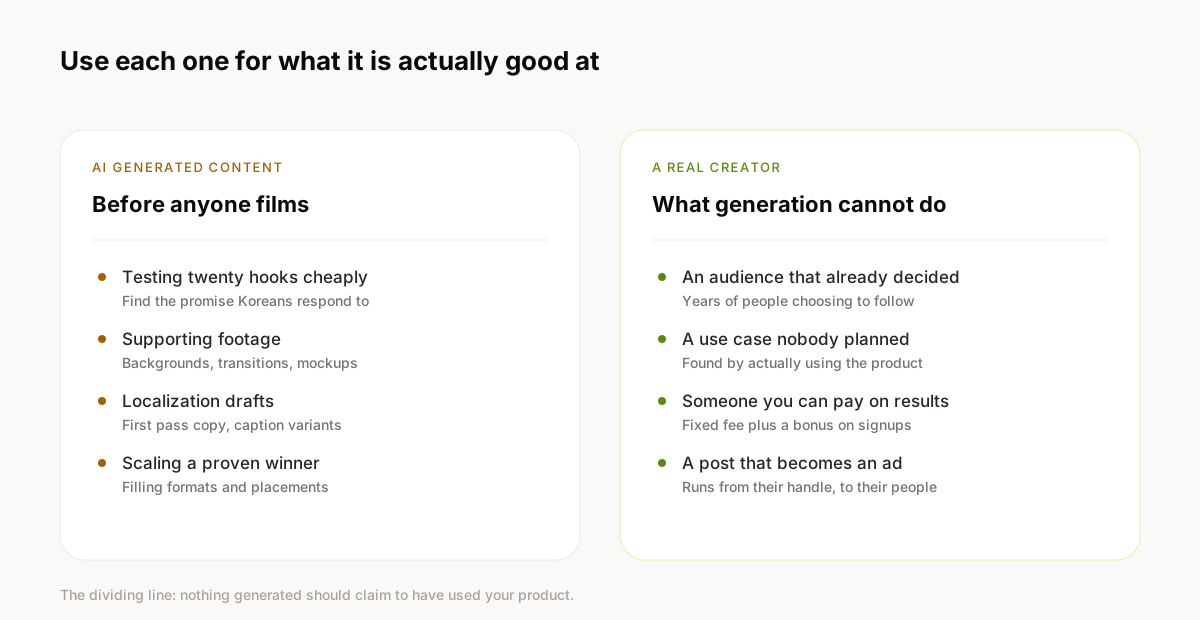
Testing angles before you spend on people. You can generate twenty variations of a hook, run them cheaply, and find out which promise Koreans respond to before a creator ever films. This is the highest value use and it costs almost nothing.
Supporting footage. Backgrounds, transitions, motion graphics, screen mockups. Nothing here is endorsing anything, so the disclosure question does not arise in the same way.
Localization drafts. First pass Korean copy, caption variants, subtitle timing. A Korean speaker still has to fix it, but the draft saves real time.
Scaling a winner into formats. Once a creator video works, generated variants of the surrounding assets let you fill placements faster.
What these have in common is that none of them involve a synthetic person claiming to have used your product.
Where a real creator is doing something else entirely
Three things you are buying that generation cannot produce.
An audience that already decided. Someone spent years collecting people interested in one subject. Those people chose to follow and kept choosing. There is no targeting setting and no generated persona that reproduces that list.
A use case nobody planned. When a creator actually uses the product in Korean, things come out that were not in the brief. A workflow you did not know Korean users wanted. In our campaigns this is often the most valuable thing produced, and it only comes from real use.
Someone who can be paid on the result. There is a person on the other side, so the deal can be a fixed fee plus a bonus on signups. You cannot structure an incentive with a generated character.
A split that works
If you are launching a subscription or paid product in Korea, this is roughly how I would allocate.
Use AI to find the angle. Twenty hooks, cheap tests, no people involved. Keep the two or three that move.
Put real creators on the winning angles. Give them real accounts and let them find their own version of it. This is where the budget goes.
Turn the creator video that converted into your paid ad. It runs from their handle, to the people who already engaged with it.
Use generated assets around the edges. Supporting footage, formats, variants.
Label anything synthetic that speaks in a human voice, and never let it claim an experience.
Where OpenLime fits
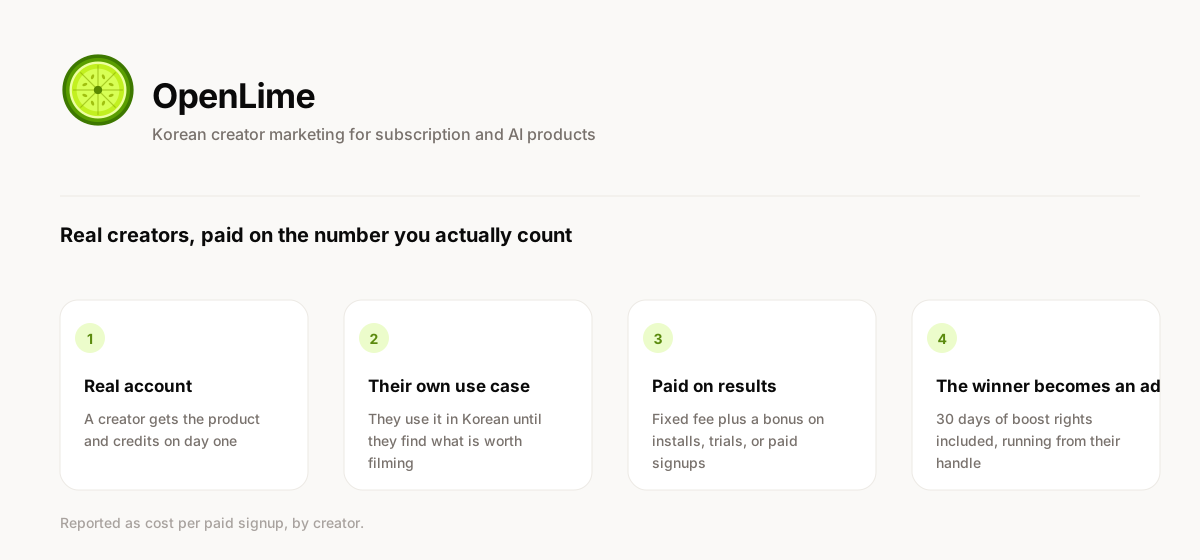
OpenLime is for the second step. Subscription and paid products where someone has to watch a task get finished before they pay, and where you want to know which creator produced which signup.
A creator gets a real account and credits on day one, finds their own use case, and posts to their own audience. Their fee is a fixed amount plus a bonus on the metric you pick. Every creator we contract includes 30 days of boost rights, so the video that converted can run as a Meta ad the same week. The report shows cost per paid signup by creator.
If you want to test twenty hooks with generated content first, do that. It will make the creator brief better and the budget go further. Just do not put the generated person in front of the Korean audience and ask them to vouch for something they never used.